The New Standard for B2B Content
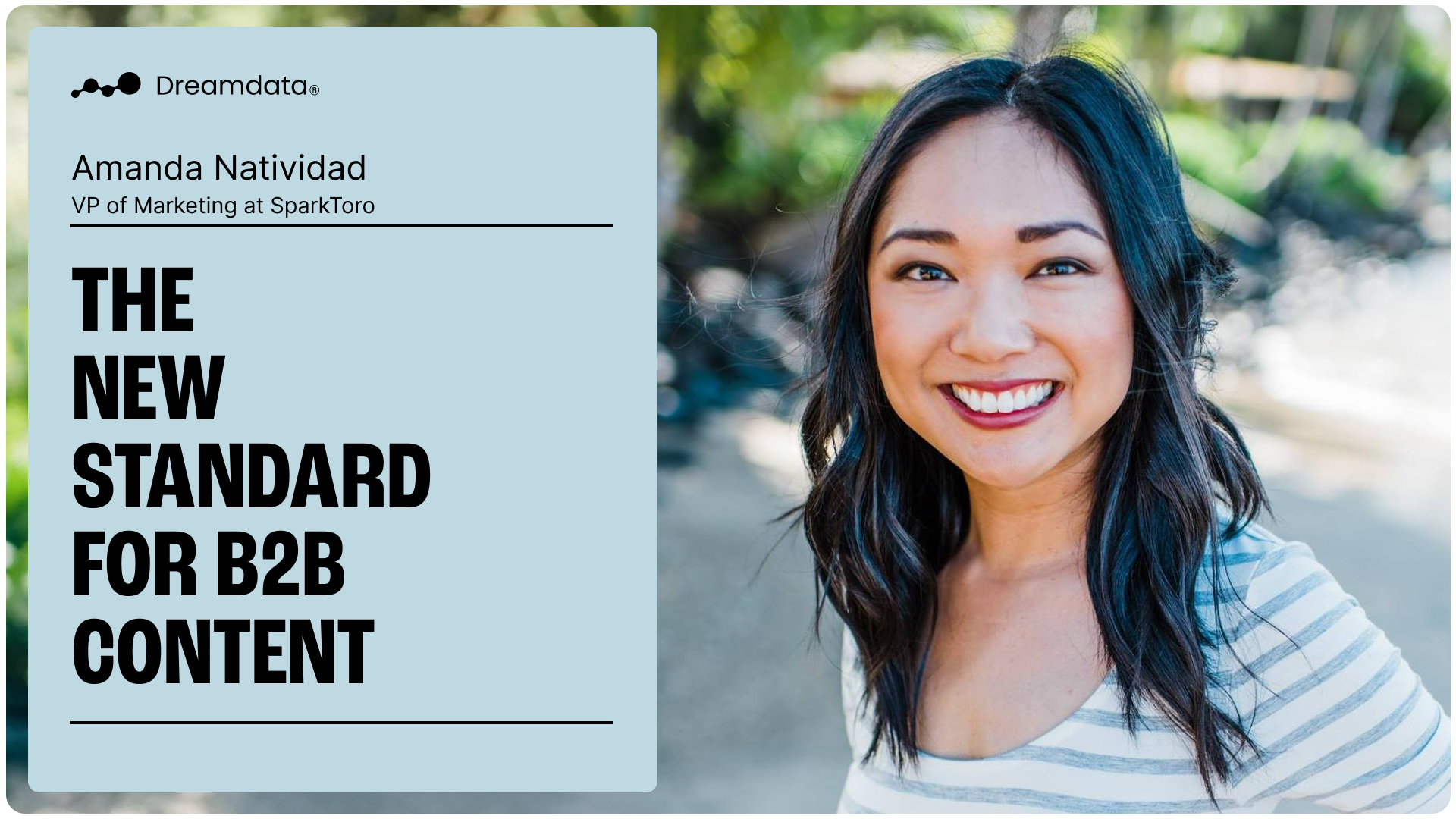
TLDR: Amanda Natividad, VP of Marketing at SparkToro, explains why Content 101 is dead, why you should give away your secrets, and why AI isn’t replacing Google just yet.
The average B2B customer journey now takes 211 days from first touch to closed won (as stated in our 2025 LinkedIn Benchmarks Report). That is seven months where your potential buyer is researching, doubting, and vetting you.
If your content strategy is just a series of thinly veiled sales pitches and gated ebooks, you are likely going to lose the potential customer in month three.
To survive a seven-month sales cycle, you don’t need more content; you need sustainable content.
On the Attributed Podcast, we spoke with SparkToro’s VP of Marketing, Amanda Natividad, about moving beyond the basics and creating work that does the heavy lifting for you.
Here is the new reality of content that actually moves the needle.
You can listen to the full conversation with Amanda Natividad here.
Moving From "Content 101" to "Content 201"
Amanda explained that most companies are stuck in Content 101.
This is the foundational phase: you are setting up the blog, debating subdomains versus subdirectories, and publishing your first white paper. It is necessary work, but it is not competitive work.
Content 201 is where the market is won.
According to Amanda, Content 201 is about arbitrage and sustainability. It asks: Now that the blog is live, what is the next channel? Is it a podcast? Is it a newsletter?
In essence, you need to find a format that lets you repurpose your best ideas without burning out your team.
The goal of Content 201 is to build an ecosystem where one idea feeds five different channels.
The "Guess and Test" Method for Audience Research
There is a prevailing myth that you cannot make a marketing move without conducting fifty expensive customer interviews. While speaking to customers is valuable, it is also costly, both in budget and time.
Amanda proposes a pragmatic alternative for B2B teams: to guess and test.
Identify job titles you target. Find people with those titles who post online. Follow them.
Find out what they are complaining about and who they are arguing with in the comments.
Create content that addresses those specific complaints. If it flops, you lost an afternoon, not a quarter’s budget.
Redefining Quality and Framing Content as a Service
Debates about quality usually devolve into subjective arguments about design or tone. For example, does this look premium? Is the font right?
Amanda suggests shifting to content as a service, meaning stripping away vanity and looking at utility.
Every piece of content has a client (the internal stakeholder or the customer) and a specific job to do.
Consider a case study:
The subjective view: Does it have high-resolution photography and a sleek layout?
The "service" view: Does it contain the three specific bullet points the sales team needs to close a deal?
If a text-heavy Google Doc helps a sales rep close a $50k contract, that is high-quality content. If a beautiful PDF gets ignored by the prospect, it is low-quality content.
Stay Away From the Definitive Guide Fallacy
If you publish an ‘Ultimate Guide’ every month, you are lying to your audience.
If it is definitive, you make one, and then you're done for the next three years.
Amanda explains that the B2B industry is flooded with gated assets that promise the world and deliver a fill-in-the-blank template. This erodes trust. The new strategy is to produce fewer, significantly deeper assets that actually give away interesting information.
In practice, this looks like meeting people where they are. Many people who consume your content cannot afford you yet. That is fine. Give them the information they need to grow their business to the point where they can afford you.
Create one or two massive, truly definitive pieces a year. Spend the rest of the year on short-tail content (social, newsletters) that distributes those ideas.
The Reality of AI and Search
There is a panic that ChatGPT is replacing Google. Amanda suggests otherwise.
She points to data indicating that roughly 70% of ChatGPT prompts are not search-like behaviors (they are coding, summarizing, or creative writing). Furthermore, Google processes trillions of searches a year compared to OpenAI’s billions.
This means the strategy for showing up in an AI answer is remarkably similar to the strategy for showing up in a human conversation: be the brand that people cite.
If your content is referenced by experts, shared on social media, and linked to by other reputable sites, the LLMs will find it.
Conclusion
Moving from Content 101 to 201 requires the confidence to give away your best insights for free and the patience to withstand a 211-day sales cycle without panicking.
In a sea of AI noise and generic guides, utility is your only competitive advantage.
About the Speaker
Amanda Natividad is the VP of Marketing at SparkToro, serving as the tactician in the trenches. She specializes in replacing abstract thought leadership with sustainable, executable strategies.